SEO vs GEO: What's the Difference and Which Does Your Business Need in 2026?
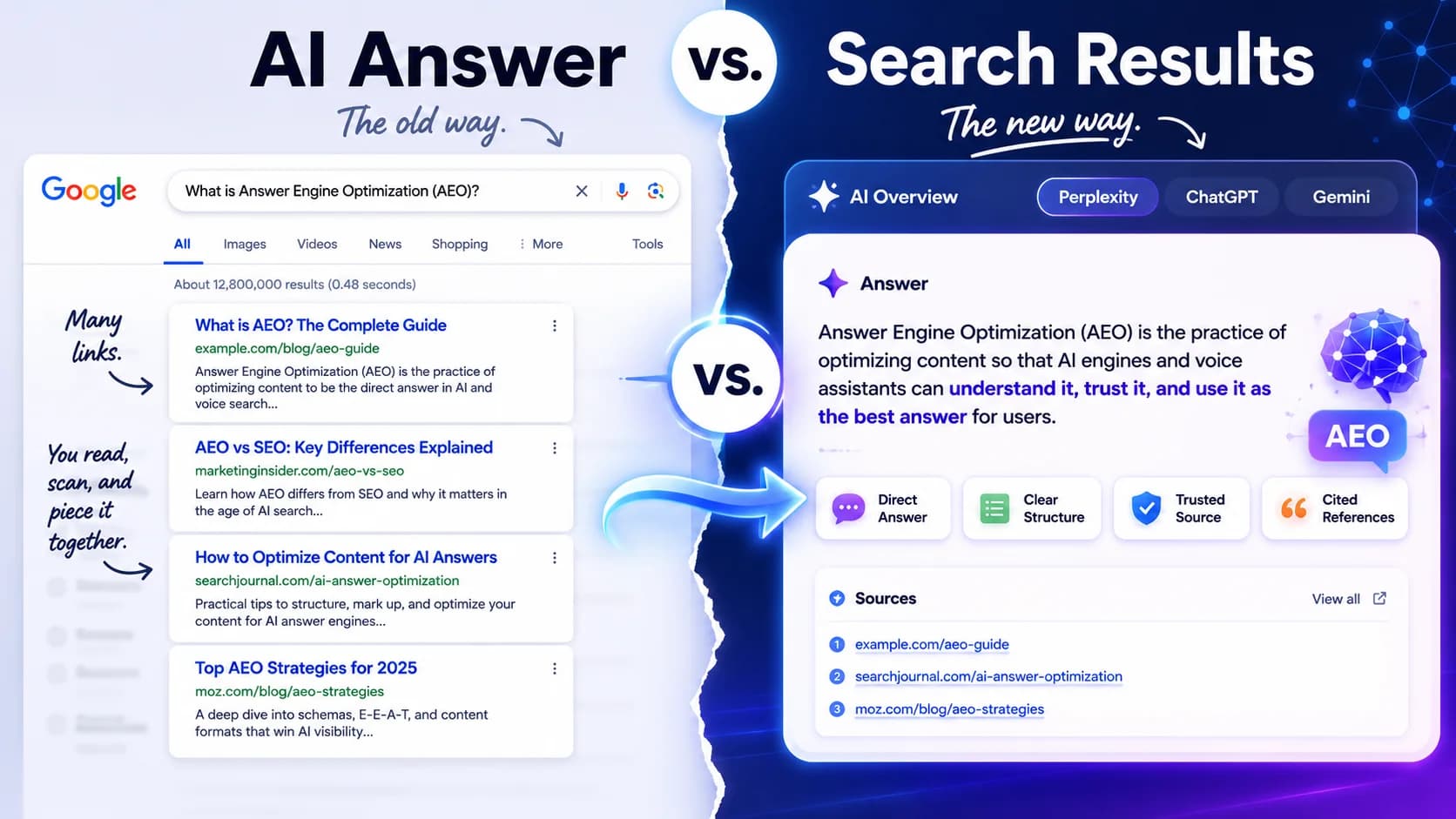
SEO targets rankings on Google; GEO targets mentions inside AI answers. A clear comparison of goals, tactics and metrics, and how to run both.
On this page
For twenty years, search marketing meant one thing: rank higher on Google. Today a buyer might never see a results page. They ask an assistant, get a synthesised answer with three or four brand names, and shortlist from there. That shift created a second discipline — Generative Engine Optimization (GEO) — and a lot of confusion about how it relates to SEO.
The short answer
SEO helps your pages rank in search results. GEO helps your brand get mentioned and cited inside AI-generated answers. They share most of their foundations, but they optimise for different outcomes and need slightly different tactics.
Side-by-side comparison
- Goal — SEO: a high ranking for a page. GEO: a mention or citation inside an answer.
- Unit of success — SEO: clicks and organic leads. GEO: share of AI answers and how you are described.
- Key signals — SEO: relevance, links, page experience. GEO: entity clarity, corroboration across trusted sources, extractable facts.
- Content style — SEO: comprehensive pages matched to intent. GEO: clear definitions, numbers, comparisons and direct answers models can quote.
- Measurement — SEO: Search Console, rankings, GA4. GEO: prompt tracking across assistants, referral traffic from AI tools.
Where the work overlaps
Fast, crawlable pages; a clean site architecture; structured data; genuinely expert content; and a strong reputation are the foundation for both. If your technical SEO is weak, AI crawlers struggle too. This is why we treat GEO as an extension of an SEO programme rather than a separate silo.
What GEO adds
Entity consistency
Your name, services, location and key facts should read the same on your site, Google Business Profile, LinkedIn, directories and press. Inconsistency makes models uncertain — and uncertain models leave you out.
Citation-worthy content
Models quote crisp definitions, numbered steps, comparison tables and original data. A page that opens with a direct answer and backs it with specifics is far more likely to be cited than a vague opinion piece.
Third-party corroboration
Reviews, industry lists, podcasts, partner pages and press coverage tell AI systems that other people vouch for you. A brand that only talks about itself looks unverified.
Which do you need?
If organic search already drives meaningful leads, protect it and layer GEO on top. If you sell considered B2B services, SaaS or high-ticket products — where buyers research heavily — GEO deserves priority, because AI assistants increasingly shape the shortlist before anyone visits your site.
Frequently asked questions
Is SEO dead because of AI search?
No. AI assistants still retrieve and cite web pages, and Google remains a major discovery channel. Strong SEO is the foundation GEO is built on.
Can a small business do GEO?
Yes. Consistent business information, a clear services page, genuine reviews and a handful of genuinely useful guides go a long way — especially in local and niche markets.
How do I know if AI assistants mention my brand?
Run a fixed list of real buyer questions through ChatGPT, Gemini, Perplexity and Google AI Overviews each month and record whether and how your brand appears.
Written by
digiPanda Growth Team
The team at digiPanda, a digital agency founded in 2016 and based in Noida, India, with offices in Melbourne and Amsterdam. We help brands get found on Google and AI search, build websites, apps and brand identity, and set up AI agents and automation.
Related services